ExperiencesCase study, ongoing
NextSpace.
An AI-facilitated platform for live and hybrid events, with a character named Berkie in the room.
Back to all work- Role
- Design lead, and acting product manager since 2026
- Where
- Applied Social Media Lab, Berkman Klein Center
- Built on
- Claude, through the Harvard API proxy
- Status
- Open source and running live events
The question
What would it feel like if the room could think with you?
Most events are one-way: people speak, people listen, and the best questions never get asked. NextSpace gives every attendee a live transcript, a private chat, a group channel, and a resources tab, all coordinated by Berkie, an AI character who knows the speakers, the topic, and the conversation so far.
How it works
- 01Prepared, not wanderingOrganizers preload Berkie with speaker bios, event descriptions, and framing documents. During an event it stays inside that material.
- 02A private companionIn private chat Berkie answers questions, summarizes what’s been said, recalls earlier sessions, and draws mind maps on request.
- 03Two group modesCollective Voice surfaces themes from private messages anonymously. Catalyst makes Berkie a participant with its own personality, nudging the room.
- 04A view for moderatorsA dedicated moderator view aggregates questions and tracks themes as they emerge.
Privacy by design
People speak more freely when they know where their words go.
- No training on participant data
- Pseudonymized identities
- Logs visible only to the product team
- Automatic transcript deletion
- Moderators see themes, not names
How Collective Voice keeps a secret
Berkie can read every private chat, so the rules for what it says out loud matter most.
- Never quotedBerkie never quotes or closely paraphrases a private message. It speaks in aggregate: “several of you,” “there’s energy around.”
- Two before oneIf only one person raised something privately, Berkie waits. A theme needs at least two independent people, or has to come up in public first.
- Unrecognizable on purposeThemes are abstracted so no one could spot their own words, even when they asked Berkie to raise the point for them.
The interface I designed
Private by default, together when you’re ready
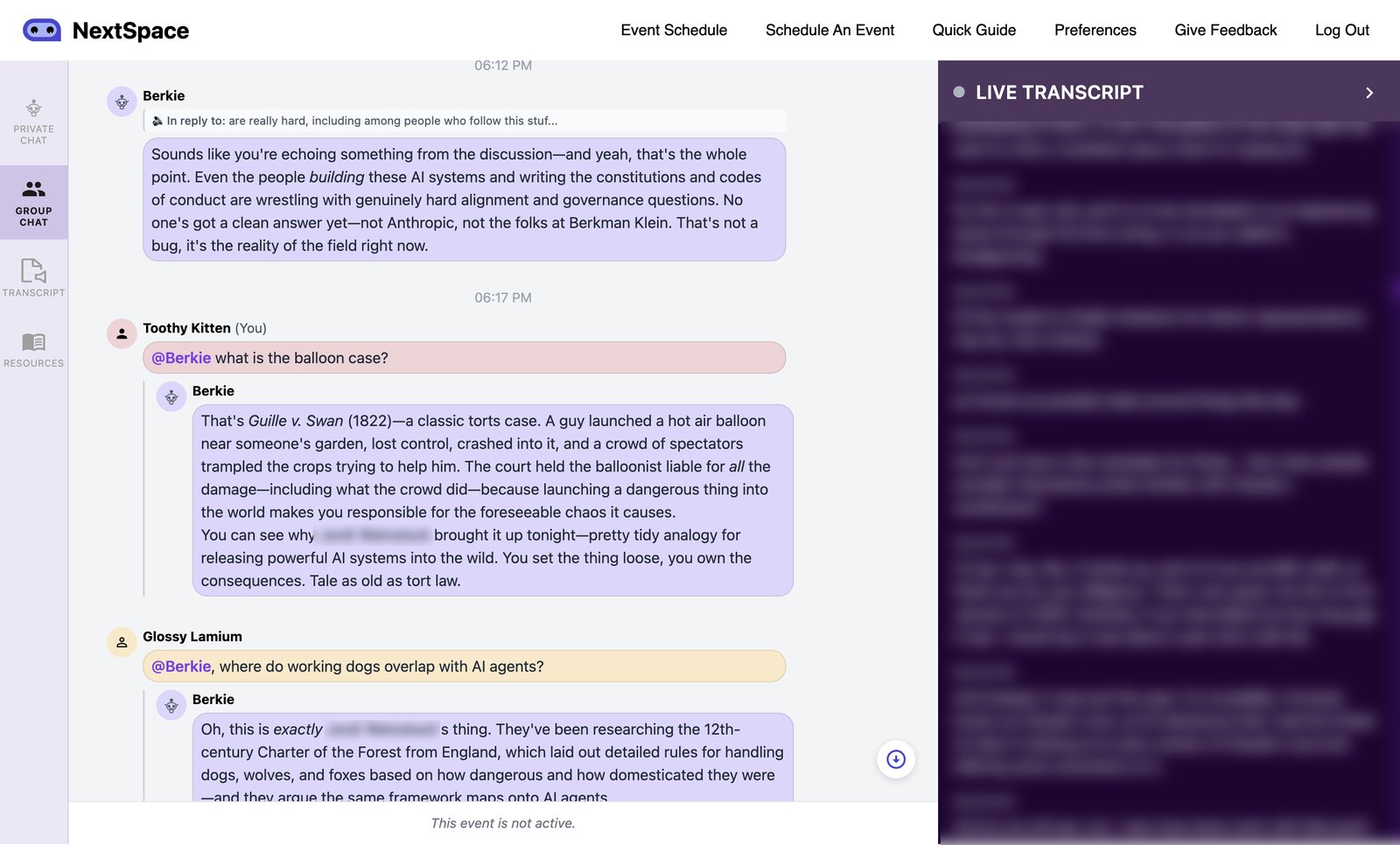
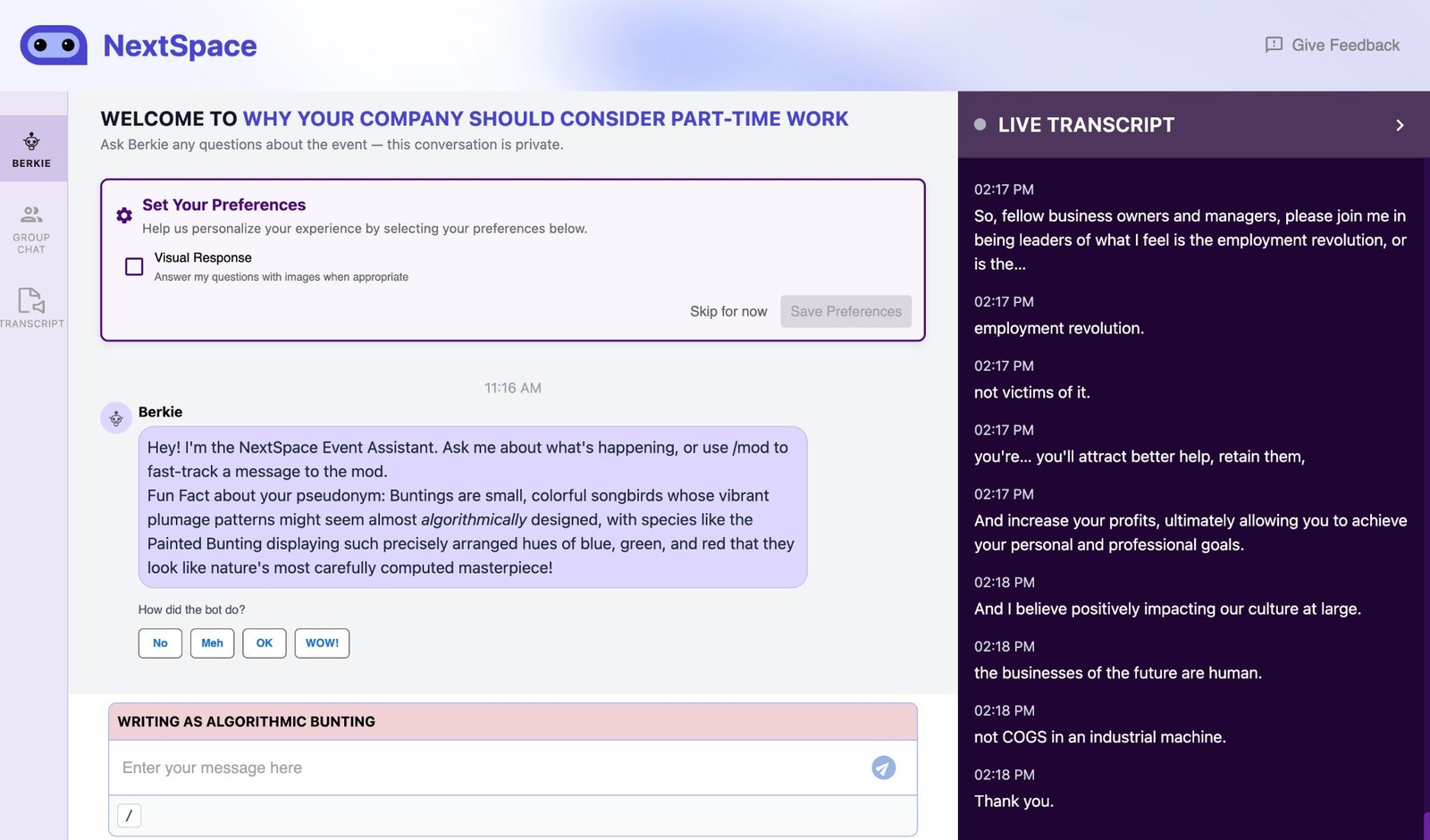
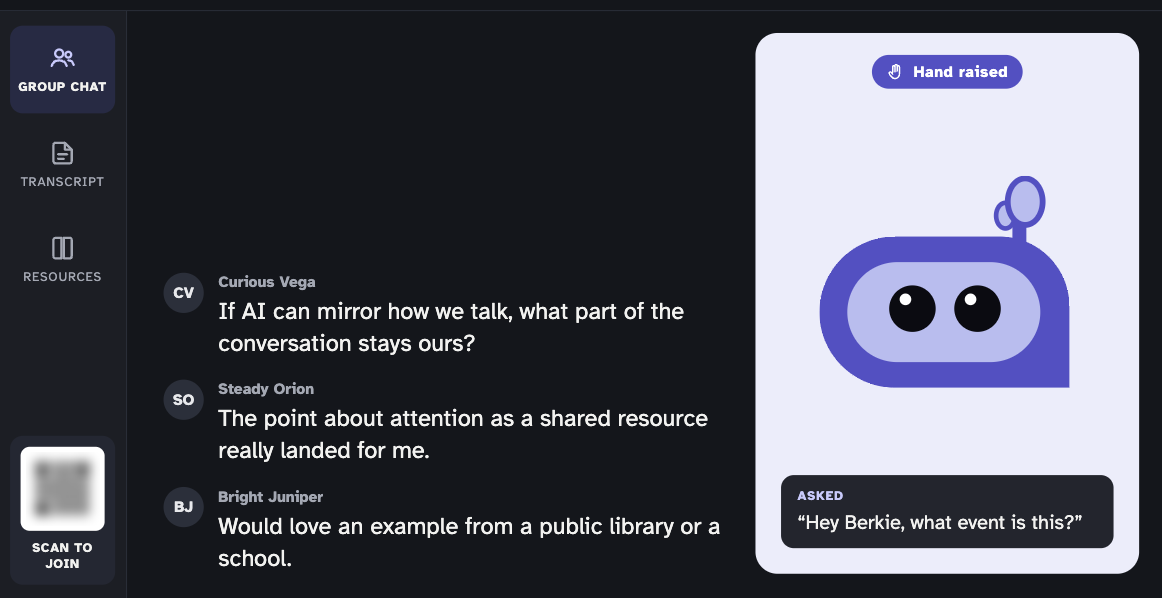
Every attendee gets a pseudonym, so people can ask the question they’d never ask out loud. Your conversation with Berkie is private. Group chat, the live transcript, and the event’s resources are one tap away, and anyone can bring Berkie into the group conversation with an @mention.
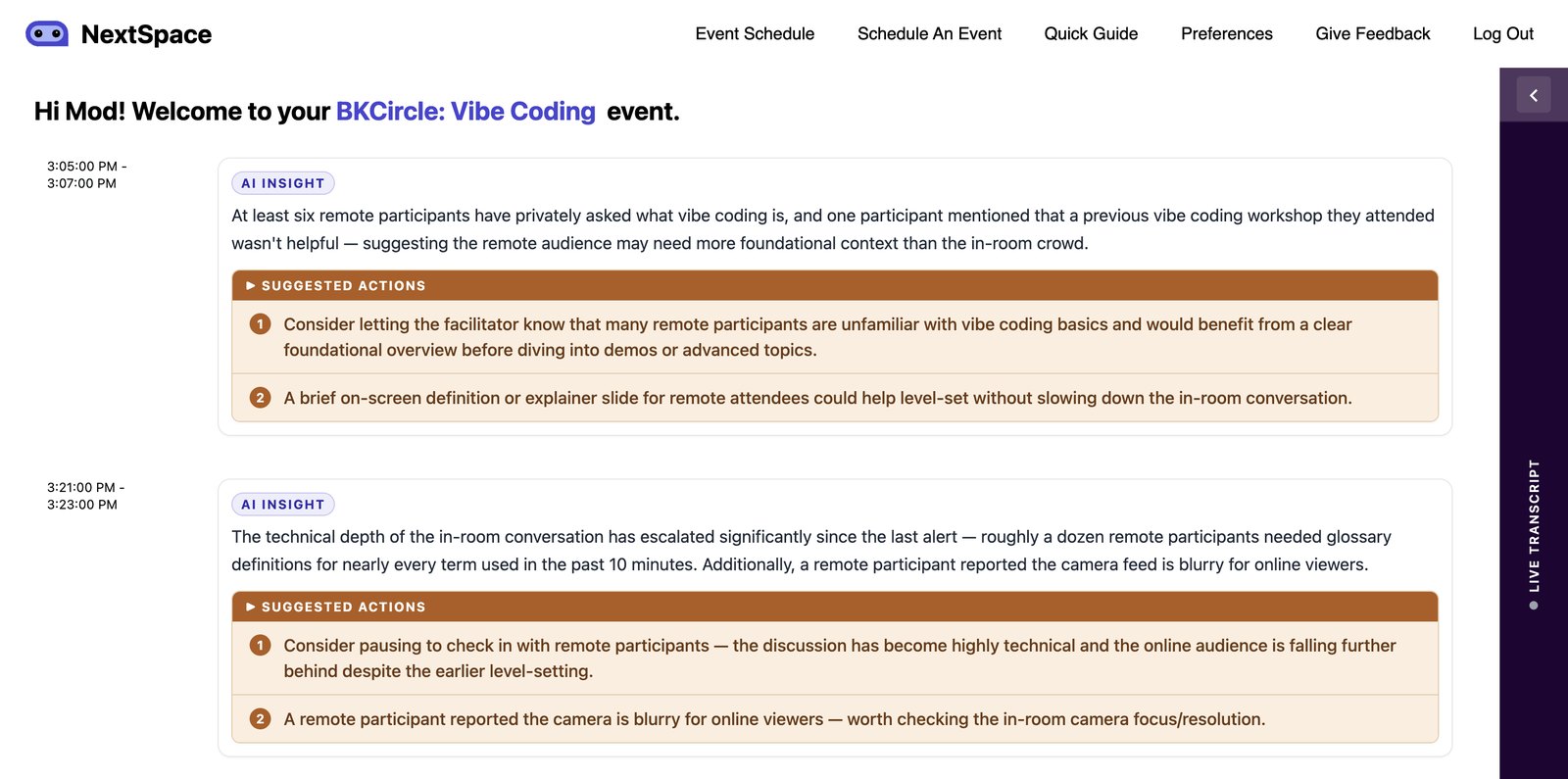
Moderators get their own view: every few minutes, Berkie turns what it’s noticing in private chats into an insight and a short list of suggested actions, without exposing who said what.
- Group chatBerkie replies in thread, with a note on what it’s replying to, and each person’s messages carry their own color.
- Moderator viewTimestamped AI insights, like noticing that remote attendees need more foundational context than the room, each with suggested actions.
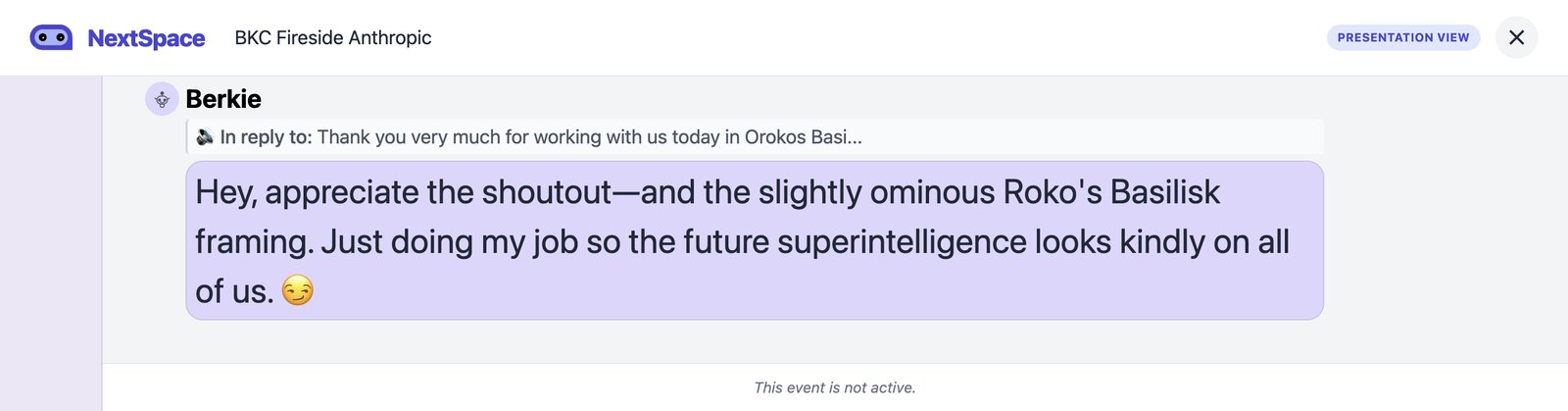
- Presentation viewLarge type for the room, so the conversation on screen is readable from the back row.
My role
From contributor to owning the design
I started as a strong contributor to NextSpace’s early design under the previous product manager, grew into owning the platform’s design, and now lead both its visual design and UX, including the handoff patterns that decide when Berkie steps in and when it holds back.
- Berkie’s intervention systemCo-developed the phase-based system that shapes Berkie’s presence across an event, welcome, ongoing facilitation, polls, and closing, with throttling logic built with Jen Hickey so Berkie fits the room.
- A bounded icebreakerPersonality-configured pseudonyms with a playful opener, and clear rules for what Berkie should and shouldn’t answer.
- Live captioningDesigned an early version of the live captioning feature.
- Berkie’s reference documentWrote the document Berkie uses to explain itself and NextSpace to attendees.
- The visual design systemLed the platform’s visual design alongside its interaction design.
Acting product manager, 2026
Running the product, not just designing it
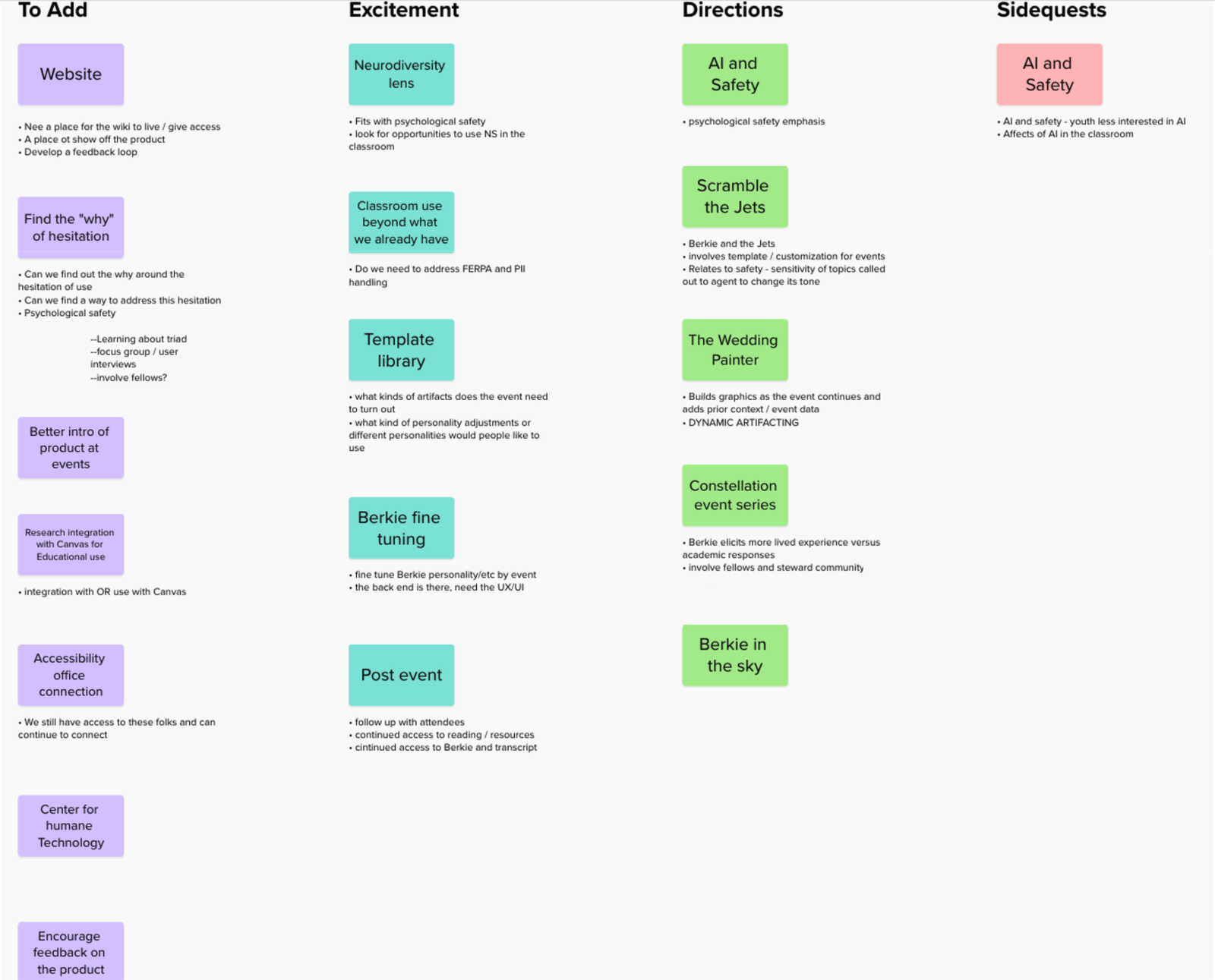
For the last seven months I’ve also been NextSpace’s acting product manager. That meant owning the roadmap, the board, the live events, and the hard calls, while still leading design.
- RoadmapA three-horizon plan through the end of 2026: stabilize for flagship live events, expand features and Harvard partners, then become the Center’s default event platform.
- ProcessA clear intake path for new tickets and a weekly board review, so priorities stay visible to the whole team.
- CadenceA running agenda with leadership, where decisions, open questions, and priorities live in one place from week to week.
- Live eventsRan Berkie live at the Navigate Digital Policy Leadership Summit, a breakout and the closing keynote, with 71 of 80 breakout participants active, plus the Uncommon Commons unconference and the Scramble the Jets rapid-response format.
- ReliabilityLoad testing and capacity planning for the real-time platform, and a candid post-event incident report when it slowed under load.
- TrustScoped the legal and privacy suite: privacy policy, terms, data retention, and FERPA.
- ReportingTechnical and summary reports for leadership after every major event, so decisions rest on what actually happened.
One year of Berkie
From a generic assistant to a character in the room
Berkie runs on an open-source engine built by the Applied Social Media Lab’s engineering team. I didn’t write its code. My part was the design, the product calls, and the rules for how Berkie behaves, so this is the arc as I saw it from the design and product seat.
- 01A generic event assistantDecember 2025. Called “Event Assistant,” it answered questions about the event and offered to pass the ones it couldn’t answer to a moderator.
- 02A name and a characterWinter into spring 2026. It became Berkie, with a configurable personality, pseudonyms that set people apart from the bot in Zoom chat, and a home in a Slack community for BKC fellows.
- 03Grounded in the readingEarly summer. Organizers could load background reading for Berkie to answer from, the groundwork for the Resources tab and post-event summaries.
- 04Reading the room by designMidsummer. Facilitation moved into small, readable goals, like “Hear another angle” and “Clear something up,” each with its own guardrails and a confidence bar Berkie has to clear before it speaks.
- 05A voice and a handLate summer into fall. Berkie learned to speak, and in Zoom it raises its hand and waits. A moderator decides when it talks.
- 06Memory across eventsFall 2026. Concept maps that grow across an event series, a pregame window before sessions start, and new experiments in Socratic questions grounded in the event’s reading.
Speaking
Talks on NextSpace
I speak about NextSpace and Berkie as AI for cognitive support, not just productivity: how the room itself can adapt to the different ways people think and communicate.
- Harvard Accessibility Summit, June 2026“What If Every Meeting Actually Worked for Everyone?” A live demonstration of AI-supported inclusion in the summit’s first AI track. Standing room only.
- CSUN Assistive Technology Conference, March 2026“Advancing Neurodiverse Inclusion with Conversational AI.” AI-powered communication support for neurodivergent people in live group settings, with live demos alongside Jen Hickey across four use cases: diverse cognition and communication, emotional regulation and psychological safety, spatial and visual processing, and creativity and meaning making.
New format
Scramble the Jets: a room within a day of the news
Scramble the Jets is a just-in-time convening format I designed and specced. When something breaks, like a model release or a policy ruling, a member of a small Brain Trust can stand up a Center-wide conversation within 12 to 24 hours. Academic events usually take weeks of planning, so the speed is the product, and Berkie is what makes it possible: no human moderator could be lined up that fast.
Before building it out, I tested the concept with about 45 affiliates who were interested in taking part, some in person and some online. These were generative interviews built entirely on questions and answers, so people could shape the format before it existed instead of reacting to a finished design.
The spec covers the parts a fast format usually skips. Speed removes the normal safety net, so a host never publishes directly: they submit a short request, and a small build team stands up the invite, the call, and Berkie’s configuration. Leadership pre-clears topic categories once, so routine news moves through a fast lane while sensitive topics get a human look first. Nothing is ever live that might need to be pulled back.
- A different BerkieHigher energy, no scripted agenda, 45 to 60 minutes. Grounding, temperature checks, and synthesis count for more, and synthesis surfaces where the room departs from the host’s framing.
- A new cool-down moveNet-new behavior for when a room tips from activated into reactive, with a separate variant for when the host is the one running hot.
- A built-in success metricEvery event closes by asking what happens next: a longer event, a working group, a paper, or nothing. Berkie logs the answer, so the format is judged by what it spawns, not by attendance.
- A planned handoffA well-known host runs the first events as proof of concept, then a briefed Brain Trust takes over, so it never calcifies into one person’s project.
Beyond NextSpace
Berkie, beyond the chat window
Berkie also lives in a Slack community for BKC fellows, and now joins Zoom meetings as a participant. When someone asks it a question out loud, it raises its hand and waits. Nothing is spoken until a moderator calls on it, and an answer nobody calls for quietly expires. I own its visual presence there; see Designing Berkie.
- PregameA pre-session protocol so Berkie is part of the event before it starts. I designed the protocol, and engineering has built its first pieces: a pre-event window and a pregame channel.
- Presentation mode v2Larger text, more screen, and room for each event’s join code.
- More than one BerkieDistinct personalities, built on the Personality Lab, instead of a voice toggle.
Product ideas I’m pitching
Where Berkie could go
A selection of ideas I’ve put in front of leadership for what NextSpace and Berkie become next.
- A Berkie familyInstead of a voice toggle, siblings with distinct personalities, like the skeptic, the connector, and the historian, that organizers cast per event.
- Personality A/B eventsRun comparable events where the only intentional difference is Berkie’s personality, then compare. Does an AI facilitator’s personality change how a human group behaves? Almost nobody has good data on that yet.
- Berkie before the roomPrinted cards with a QR code and a provocation question, plus a one-question pre-pulse a few days out that gives speakers an anonymous map of where the audience is coming from.
- Sit next to someone who disagreesIn a class, pair attendees who answered the pre-pulse in opposite ways for a breakout.
- Events as navigable artifactsEach event leaves behind a mind map, key quotes, open questions, and a reading list, and a living map connects themes across every NextSpace event. Part of this is now real: concept maps that grow with each event in a series, poll results included.
- One thing I’ll doAttendees privately note a commitment, and Berkie checks in two weeks later.
- A field notebookBerkie keeps a public notebook of patterns it sees across events, connected visibly to the Center’s archive.
- Provenance you can seeBerkie dims slightly when it’s speculating and brightens when it’s drawing on preloaded material, so you can tell where an answer comes from without a disclaimer.
Let the room think out loud.
Where it goes next
NextSpace is now the Berkman Klein Center’s mandated platform for its deliberative events, and I’ve presented it at Brookings, the Navigate summit, CSUN, and the AI track of Harvard’s first Accessibility Summit.
Next up on the roadmap: finishing the pregame, post-event follow-up, and an admin dashboard. The research question I care most about is whether different Berkie personalities change how a room behaves, measured with the Personality Lab’s five axes.
NextSpace is open source. Documentation lives on the Berkman Klein Center’s GitHub.