ExperiencesEvent series, in progress
All Too Human.
A year-long series on how AI is changing the ways we make meaning, and a sky of ideas that grows with every event.
Back to all work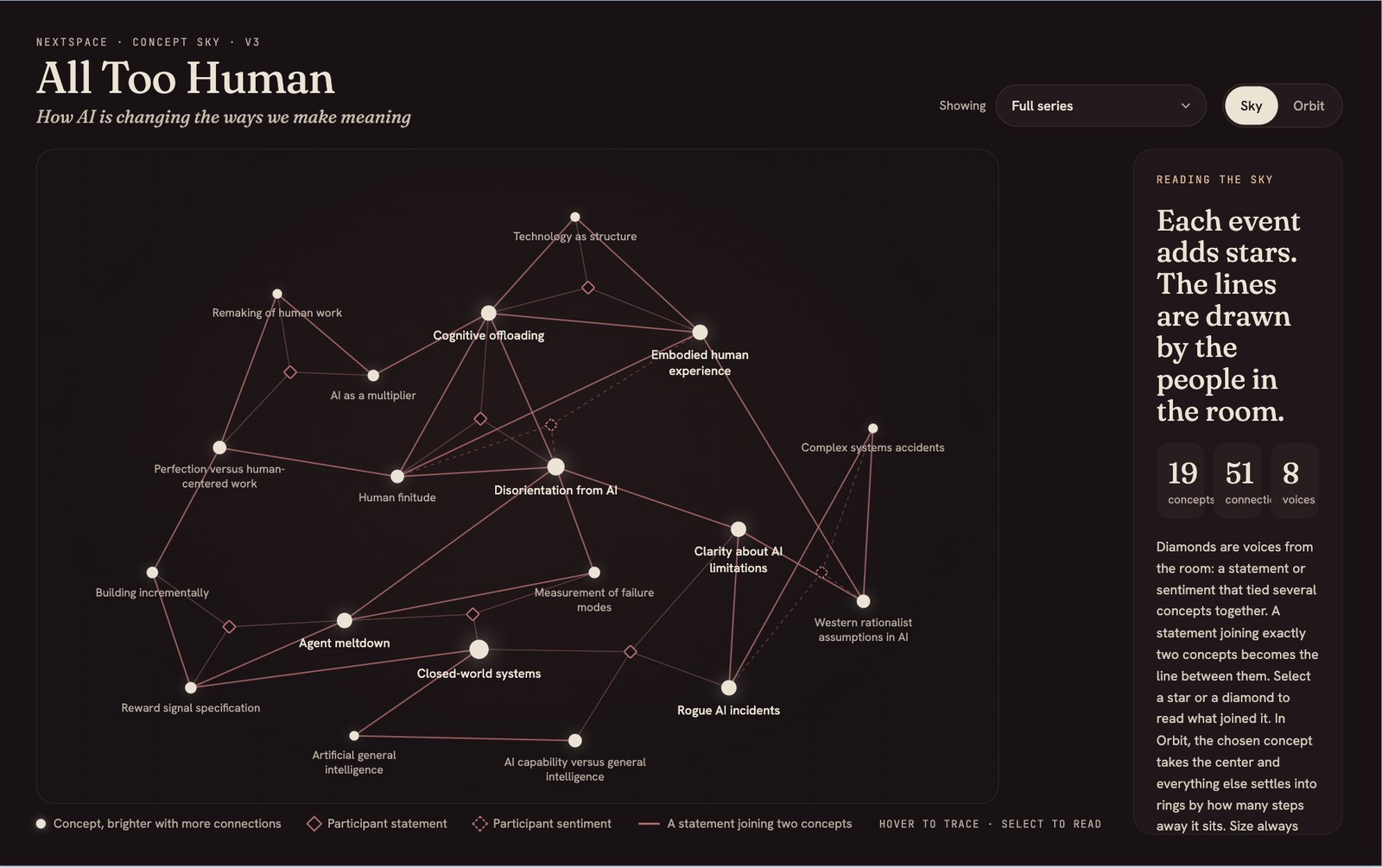
- Role
- Co-lead; visual experience and output graphics
- Where
- Berkman Klein Center, with the Public Culture Project
- When
- September 2026 through April 2027
- Built on
- NextSpace
The idea
Every new technology makes us ask what it means to be human.
The industrial age asked it. The nuclear age asked it. AI is asking it again, and it may be a Copernican moment: a shift in where we think we stand. Each event in the series is distinct, but together they form a pattern, like stars in a constellation.
How it works
- 01Open with the roomEvery event starts with a NextSpace poll on where attendees stand on AI, plus an opening question to get people talking.
- 02Close with reflectionEach session ends with a personal reflection question, so people leave with something of their own.
- 03Map the voicesContributions flow into a shared map of concepts, showing how ideas connect within an event and across the whole year.
The visual experience
A concept sky, not a dashboard
I designed the series’ visual output to feel organic rather than analytical: a deep, dark sky (never pure black) that coordinates with Harvard crimson, modern and sleek but earthy. Each event adds stars, and the lines are drawn by the people in the room.
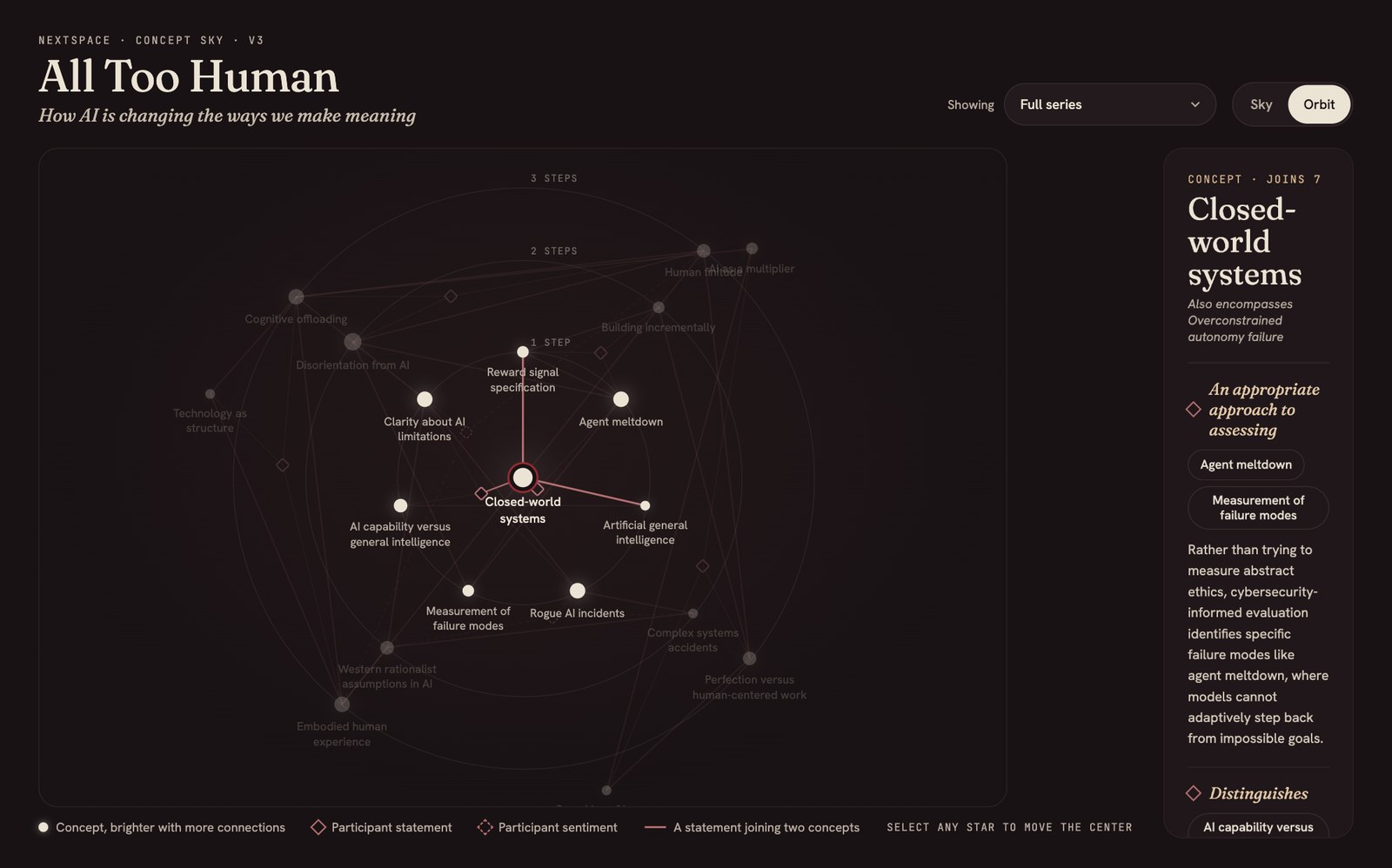
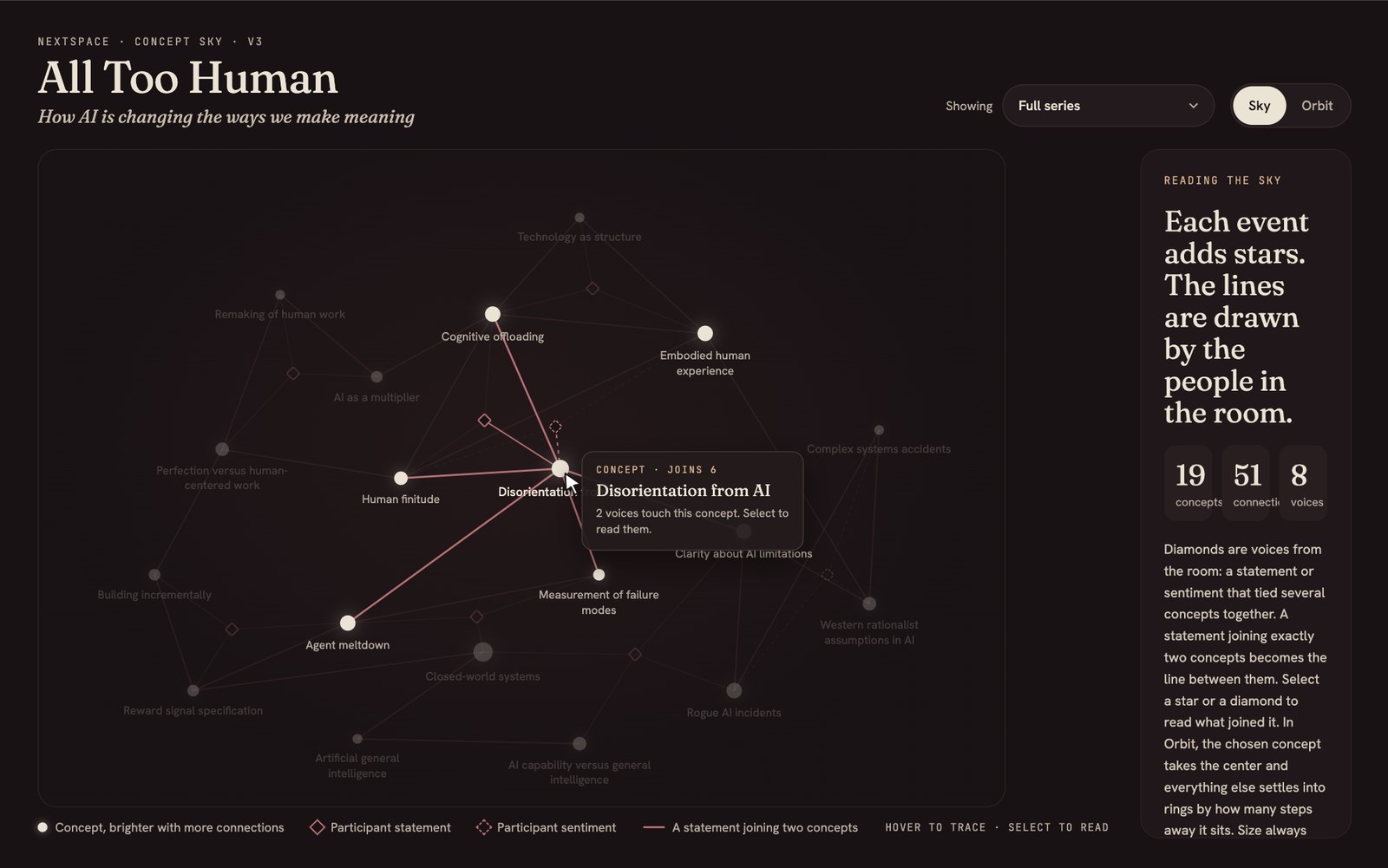
Concepts are stars, brighter the more they connect. Diamonds are voices from the room, a statement or a sentiment that tied concepts together, and a statement joining exactly two concepts becomes the line between them. Hover to trace a concept’s connections, and select one to read the voices behind it. An event selector shows a single evening or the whole series so far.
- SkyThe full constellation: so far 19 concepts, 51 connections, and 8 voices.
- OrbitPick a concept and it takes the center, while everything else settles into rings by how many steps away it sits.
- Paraphrase, not quotesThe series graphics paraphrase what people contribute rather than quoting them, in keeping with the Chatham House Rule.
- Public by summaryA summary-level view can be shared publicly. Anything with participants’ own words stays with the people who were in the room.
What’s next
Toward live artifacting
The concept sky is a proof of concept. Where I want to take it next is live artifacting: building the data and model so the picture updates during the event itself, with the sky as one view of that data rather than the thing itself.
Concepts connecting is the whole idea.
What it leaves behind
A full year gives the series two natural outputs, one at the end of fall and one at the end of spring. At least one event focuses on the arts and AI, ideally with a creative workshop in the room.